Switchgear-room form factor. PrecisionDCMS operating contract.
PrecisionDCMS Industrial Edition packages selected Field, NX, OT-network, OOB, protected-power, field-interface and local-operator functions into freestanding cabinets and multi-bay lineups designed for microgrids, generation and BESS sites, switchgear rooms, central plants and other industrial environments.
Lineup-compatible • Local, hosted or hybrid • Lite or Standard • Order-engineered
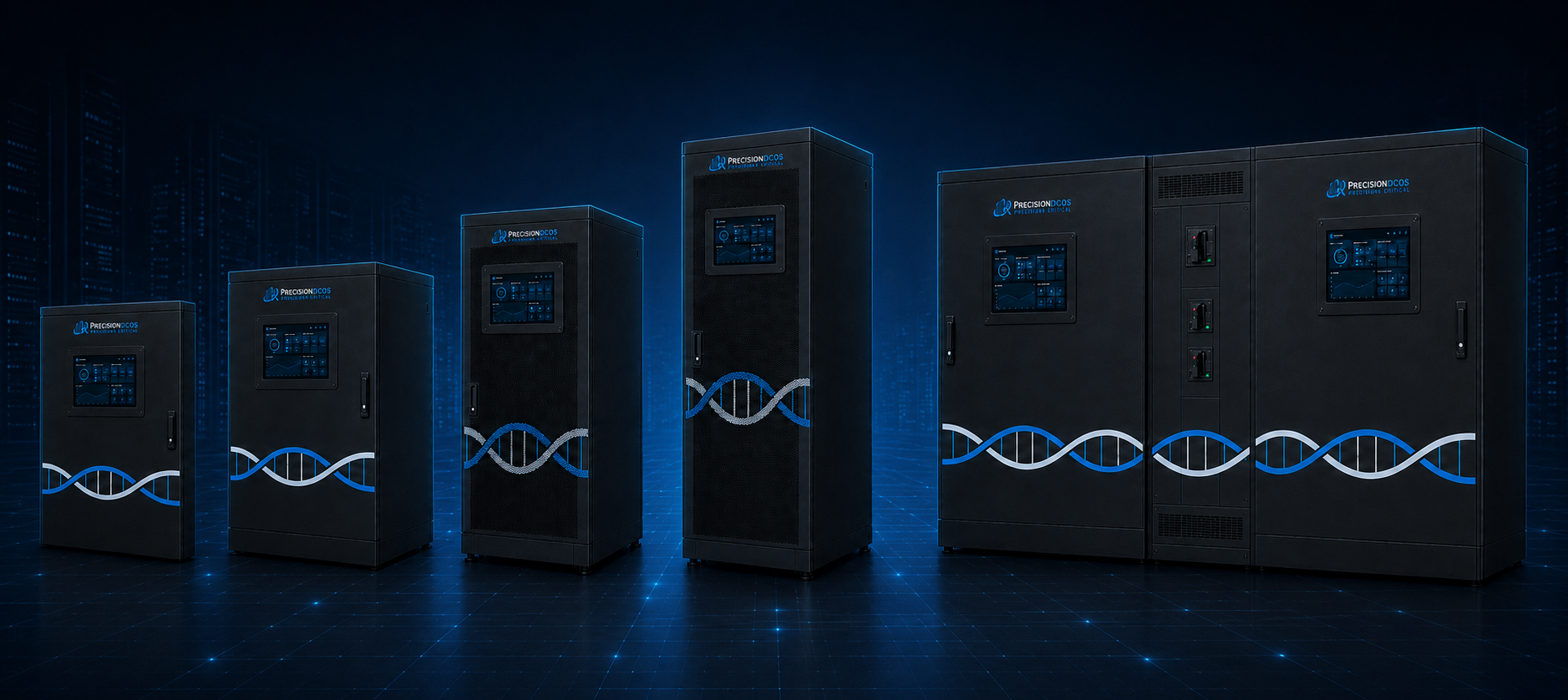
IND-S2 Industrial Standard Lineup
- Form factor
- Freestanding single- or multi-bay industrial lineup
- Runtime
- Field, NX, Field + NX, or Field + NX-Cloud
- Availability
- Lite or Standard
- Environment
- Switchgear room, microgrid building, generation/BESS, central plant or industrial control space
- Authority
- Deployment-selected; protection remains local
- Build
- Engineered, staged and FAT/SAT accepted
Product role
A productized industrial package—not a new alarm or control authority.
Field and NX continue to define how PrecisionDCMS acquires and operates on data. Industrial Edition packages those proven functions in a floor-standing assembly with protected power, field termination, OT networking, OOB, local HMI and service access. The product uses the same stable asset and point identities, quality states, alarm lifecycle, authority model, evidence fields, APIs and migration rules as the rest of PrecisionDCMS.
Industrial Field
Field Core, PFC300-class acquisition, modular I/O, protected control power, optional IO/GMS interfaces, Edge Continuity and local HMI in a freestanding industrial cabinet.
Industrial NX
Local NX services installed in an environmentally qualified cabinet or lineup compartment with protected rack power, BMC/OOB, network segregation and local operations.
Industrial Hybrid
Field acquisition and protected interfaces combined with local NX or hosted NX-Cloud, plus OT networking, OOB and service functions in one coordinated lineup.
Industrial Edition does not add a sixth deployment model. It implements the existing Field Standalone, Field + NX-Cloud, Field + local NX or NX Local patterns in an industrial physical package.
Select Industrial Edition when the installation should behave like engineered plant equipment.
- The primary installation location is a switchgear room, microgrid building, generation plant, BESS building, central cooling plant, utility room or industrial control space.
- The customer wants freestanding hardware that visually and mechanically belongs beside electrical or mechanical lineups rather than in an ordinary IT rack.
- A centralized field-cable landing point is preferable to many smaller wall enclosures.
- Point count, network demarcation, OOB, power distribution or service access justify multiple internal compartments or bays.
- Door-mounted local HMI and service status are required.
- Independent A/B hardware should be arranged as a coordinated lineup.
- The site uses industrial control power, field wiring, fiber, serial or protected-network interfaces.
- The environment needs engineered cooling, filtration, corrosion protection, cable entry, grounding or physical-security provisions.
- A complete factory-staged hardware package is preferable to field assembly of unrelated cabinets and rack devices.
Comparison note
Choose distributed Field enclosures when acquisition should remain close to equipment. Choose NX rack hardware when the environment is Ethernet-native and a conditioned technical rack is available. Choose Industrial Edition when the functions should be consolidated into a freestanding plant-floor lineup. Many sites use all three.
The same PrecisionDCMS runtimes in an industrial package.
IND-A — Industrial Standalone
Maps to: Deployment A — Field Standalone
- One Industrial Field Core for Lite or two for Standard
- Complete local PrecisionDCMS monitoring runtime
- Optional PrecisionDCMS IO
- Monitor-only GMS interfaces
- OT switching and local network services
- Local HMI
- Local history, users, alarms, notifications and reports
- Optional OOB and cellular
- No Cloud dependency
Best fit — Small or moderate microgrid, plant or packaged industrial facility requiring complete local operation
IND-B — Industrial + NX-Cloud
Maps to: Deployment B — Field + NX-Cloud
Preferred when physical I/O exists and hosted multi-site operations are desired
- Industrial Field Connected Edge
- PFC and physical acquisition
- Edge Continuity
- Site Connector and Zabbix proxy
- Durable bounded queues
- OT network and OOB
- Local HMI and critical subset
- NX-Cloud authoritative monitoring, history, workflow and customer views
- Optional Local Continuity Pack
Best fit — Energy-integrated data centers, microgrids, generation/BESS sites and remote industrial facilities using central operations
IND-C — Industrial + Local NX
Maps to: Deployment C — Field + NX Local
- Industrial Field acquisition and interface bays
- Local NX Lite or Standard
- Complete local facility and cluster monitoring
- Local data, users, alarms, reports and APIs
- Optional Cloud federation
- OT network and OOB
- Door HMI plus local NX operator access
Best fit — Air-gapped, sovereign, highly isolated or fully local industrial sites
IND-D — Industrial NX Local
Maps to: Deployment D — NX Local Only
- Industrial cabinet with environmentally qualified NX Lite or Standard
- Direct Ethernet-native acquisition
- No base physical I/O
- Protected BMC, OOB and network interfaces
- Local monitoring, history and operations
- Optional bounded Field package added later
Best fit — Ethernet-native plants or energy facilities that require an industrial freestanding package rather than a data-center rack
Deployment E — NX-Cloud Only contains no PrecisionDCMS site appliance and therefore has no Industrial Edition hardware. An independently monitored facility may still use a separate DCOS Network/OOB industrial cabinet, but that is not an Industrial Edition monitoring authority unless ordered as such.
Reference configurations from compact cabinet to A/B lineup
Reference architecture — final dimensions, ratings, components and capacity are order-specific.
IND-C1 — Compact Industrial Cabinet
Single-bay floor-standing package for Field Lite, a bounded Field acquisition role, OT/OOB services or a compact local monitoring scope.
Typical contents
- One Field Core or approved industrial x86 package
- PFC and modular I/O as required
- Protected control power
- Compact termination
- Industrial switch
- Site Connector
- Local HMI
- Optional OOB/cellular
IND-F1 — Full-Height Industrial Cabinet
Expanded single-bay package for higher point counts, IO conditioning, field termination, network/OOB, local history and service access.
Typical contents
- Field Lite or Standalone runtime
- PrecisionDCMS IO or expansion I/O
- Segregated power and signal sections
- Industrial OT switching
- OOB gateway
- Local HMI
- Expanded top or bottom cable entry
- Optional external GMS interface
IND-H1 — Industrial Hybrid Cabinet
Segregated Field and local-NX package for a site that requires both physical acquisition and complete local full-stack monitoring.
Typical contents
- Field/PFC compartment
- IO and terminal compartment
- Environmentally managed 19-inch NX section
- BMC and console/OOB
- OT and service switching
- Local HMI
- Separate power and network paths according to edition
IND-S2 — Industrial Standard Lineup
Dual-bay Standard architecture with independent A and B functional bays and a narrow center service, control-power and interface bay.
Typical contents
- Left Core A / Node A bay
- Right Core B / Node B bay
- Independent A and B power inputs
- Independent A and B network paths
- Matching local HMIs or one governed operator view as ordered
- Center branch protection and source-status section
- Network/fiber demarcation and service interfaces
- Optional segregated field termination
- Authority and A/B diagnostic feedback
- Optional local NX compartments
- Optional OOB and cellular
- Explicit shared-element and common-mode schedule
IND-X — Custom Industrial Lineup
Order-engineered multi-bay or skid-integrated package for large I/O counts, multiple buildings, remote I/O, specialized environmental requirements, customer-standard hardware or packaged power and cooling plants.
Reference industrial standard
Two independent functional sides with one deliberately bounded center bay.
Left A bay
- Field Core / NX Node A
- Network A
- Power A
- Local HMI A
- Queue / history / state
Center service bay
- A/B branch protection
- Source status
- Fiber / network demarcation
- Service / test interface
- Segregated terminals
- No hidden shared logic
Right B bay
- Field Core / NX Node B
- Network B
- Power B
- Local HMI B
- Queue / history / state
Industrial Standard follows the same PrecisionDCMS Standard rule as every other hardware form: two independently powered and networked matching nodes with tested coordination, explicit leader/follower or approved active/active behavior, fenced singular actions and no shared-storage dependency in the base local architecture.
Two doors do not make redundancy
Two cabinet doors, two processors or two power supplies do not establish Standard availability. The design traces each node, power supply, branch, switch path, source, field signal and upstream dependency. Shared elements in the center bay are identified and classified rather than hidden.
Center-bay rule
The center bay may contain separately segregated A and B branch protection, source-status indication, service disconnects, network and fiber demarcation, test interfaces or accepted common field termination. It may not contain an undocumented single active controller, power source, switch, gateway or command path on which both A and B functions depend.
A coordinated cabinet system, not loose rack equipment behind a larger door.
Industrial Enclosure
Freestanding steel or approved corrosion-resistant construction, plinth, doors, service clearances, locking, ventilation and order-specific environmental rating.
Field and Compute
Industrial x86, PFC300-class controller, modular I/O, optional local NX server section and controlled software baseline.
Protected Power
One or two approved AC or DC inputs, regulated control power, ORing where used, hold-up where ordered, electronic branch protection and source/branch health monitoring.
IO and Termination
Field terminals, shields, earth bars, isolation, conditioning, quick-connect harnesses, A/B fanout, test points and diagnostics.
OT Network
Managed switching, routed segmentation, fiber/copper interfaces, DNS/time dependencies, certificate identity and configuration backup.
OOB and Recovery
Site gateway, console, BMC paths, private access, cellular or alternate WAN, local recovery packages and full-path health.
Local HMI
Door-mounted status, alarms, source quality, availability, maintenance and permitted local operation with role and session controls.
Service and Evidence
Configuration, drawings, labels, point and port schedules, test records, software versions, backups, spares and QR or controlled document references.
Protected control power with an explicit relationship to the site electrical system.
- AC or DC input source selected by the approved site design
- One or two independent inputs according to Lite/Standard and the availability objective
- Lockable or guarded disconnecting means as applicable
- Surge and transient protection selected for source and exposure
- Industrial power conversion
- Active or diode ORing where designed
- DC hold-up or controlled shutdown where required
- Electronic branch protection
- Separate monitoring of compute, PFC, I/O, network, HMI, OOB, accessories and outputs
- Source, PSU, branch, battery/hold-up and enclosure-temperature monitoring
- A/B power paths traced to actual upstream sources
- NX server power mapped to documented rack or cabinet power sources
- GMS safety power remains independently engineered
Power boundary
Industrial Edition does not distribute medium-voltage or low-voltage switchgear bus power. Where higher-voltage site power is used to supply the cabinet, transformation, disconnecting, protection, SCCR, grounding, labeling and listing requirements are order-specific and controlled by the approved design and delivered nameplate.
The center-bay protective devices shown in product imagery represent DCMS service and branch-protection functions. Do not describe them as feeder, switchgear or distribution breakers unless the delivered assembly is specifically engineered and labeled for that function.
Designed for the cable and service reality of an industrial room.
- Top or bottom field-cable entry
- Segregated power, relay, digital, analog/RTD, serial, Ethernet and fiber pathways
- Pluggable labeled terminals
- Shield and protective-earth bars
- Mechanically keyed A/B harnesses
- Industrial copper and fiber network demarcation
- Serial gateway or one-master architecture
- Front-accessible service and test points where appropriate
- Field wire numbers, point tags, terminal references and cable schedules
- Optional remote-I/O or distributed Field enclosures for distant equipment
- No uncontrolled bridging between OT, OOB, security, enterprise or customer-management networks
Local visibility designed for the room—not a public control surface.
- Site and lineup health
- Power-source and branch status
- Core/Node A and B role and availability
- OT network, OOB and Cloud-path health
- Source quality and stale state
- Active alarms and local-continuity events
- Maintenance and out-of-service state
- A/B disagreement
- Queue and replay state
- GMS monitor-only status where present
- Permitted S3/S4 actions only where ordered
- No raw arbitrary register writes
- Named user or controlled local service access
- Session timeout and audit
- Local fallback view during WAN or hosted-service loss according to configuration
A door-mounted HMI does not expand command authority. The same role, mode, interlock, expiration, feedback and audit rules apply locally and remotely.
Engineered for industrial rooms without overstating the enclosure.
Indoor switchgear and control rooms
Painted-steel Type 1/12-class or approved equivalent reference design with filtered or closed-loop thermal management as required.
Wet, dirty or outdoor-adjacent locations
Gasketed Type 3R/4 or approved equivalent where ordered, with sun, rain, condensation, heater, drain/breather and cooling requirements evaluated.
Corrosive locations
Type 4X-class or approved corrosion-resistant construction where ordered after materials and environmental review.
NX environmental compartment
Local NX servers are installed only where inlet temperature, contamination, airflow, altitude, vibration and service requirements satisfy the selected enterprise platform. Otherwise NX remains in an adjacent conditioned rack or separate cabinet.
Hazardous locations
The standard Industrial Edition is not represented as explosion-proof or suitable for a classified location. Hazardous-area interfaces require separate engineering and approved protection methods.
Switchgear adjacency
Coordinate working clearance, door swing, ventilation, cable access, grounding, fire separation, arc-flash boundaries, maintenance access and future lineup extension. Visual alignment with adjacent switchgear does not make the DCMS cabinet part of the switchgear assembly.
Non-negotiable boundary
Monitor broadly. Command narrowly. Keep protection local.
- Electrical protection remains with protective relays, breakers and the designated electrical authority.
- Microgrid dispatch and generation control remain with the approved EMS, plant controller or OEM controls unless an order-specific supervisory function is engineered.
- Fire alarm, gas shutdown, emergency shutdown and equipment-local safeties remain independent.
- The ability to read a Modbus register, API or HMI does not grant authority to write it.
- Output control is optional and disabled by default.
- S0 independent safety is monitor-only.
- S1 critical electrical is monitor-only unless an order-specific restricted function is approved.
- S2 automatic mechanical logic remains local to an approved controller.
- S3 supervised operator actions require role, mode, interlocks, expiration and feedback.
- S4 indication and notification may be permitted with feedback or supervised test.
- No expired command is replayed after an outage.
- No shared center-bay element may silently become the authority for both A and B sides.
Product disclaimer
Industrial Edition is a monitoring, integration and bounded supervisory platform. It is not represented as switchgear, an MCC, a protective-relay panel, a safety instrumented system, a fire alarm control panel or a listed gas controller unless a specific order is expressly engineered, evaluated, labeled and documented for that purpose.
Industrial hardware integrated with the same central operating model.
- 24/7 NOC monitoring where ordered
- OT network and OOB monitoring
- Utility, generation, BESS, switchgear, cooling and environmental event correlation
- Carrier and remote-hub coordination
- Alarm, incident, work and change linkage
- Vendor and OEM dispatch
- Field-service and remote-hands integration
- Preventive maintenance and calibration
- Configuration backup and restore testing
- Firmware and vulnerability lifecycle
- Spares and replacement planning
- Customer status and evidence
- Compliance evidence operations
- Data Fabric and customer API delivery
- Reliability and recurring-fault review
The customer experiences one operating path even when the underlying work is performed by an OEM, electrical contractor, controls integrator, carrier or customer team.
Factory-staged, site-accepted and handed over as an engineered system.
Factory Acceptance Test
- Visual and mechanical inspection
- Nameplate and labeling review
- Power-source and branch tests
- Loss of Source A and Source B
- Hold-up and controlled shutdown where ordered
- Core/Node boot and hardware health
- PFC and I/O channel tests
- A/B comparison and source-quality tests
- OT switching, routing and firewall tests
- OOB, console and cellular tests
- HMI and user-role tests
- Site Connector, proxy and queue tests
- WAN/Cloud loss behavior
- Standard leader/follower and fencing
- Command rejection and feedback tests
- Alarm, notification and evidence generation
- Backup and restore
- Thermal and fan/heat-exchanger alarms where applicable
Site Acceptance Test
- Installed source voltage, grounding and upstream mapping
- Field cable and terminal verification
- Fiber and network path verification
- Live source and equipment onboarding
- BMS/EPMS/PLC/OEM integration
- HMI and local access
- WAN, OOB and hosted connectivity
- Failure and recovery scenarios
- Customer/NOC communications
- Authority and operational procedure
- Final as-built acceptance
Delivered documentation
- General arrangement and elevation
- Enclosure and bay schedule
- Control-power one-line
- Branch-protection schedule
- Heat-load and thermal design basis
- Network topology
- IP, VLAN, VRF and port schedule
- Field termination and wiring drawings
- Point and asset inventory
- Connector and harness schedules
- Authority and command matrix
- Cause-and-effect where applicable
- Software and firmware baseline
- Backup and recovery package
- FAT and SAT records
- Training and maintenance procedures
- Spare-parts and lifecycle plan
- Certifications, listing and SCCR documents only where applicable to the delivered product
- Customer handback package
Designed for the infrastructure side of critical compute and industrial operations.
Microgrid and Generation Plant
Integrate generator, BESS, utility, fuel, gas, environmental, switchgear and supporting-network state into the PrecisionDCOS operating model while keeping protection and plant control authoritative locally.
Switchgear and Relay Room
Place the DCMS, OT network, OOB, local HMI and field interfaces in a cabinet lineup that belongs in the electrical room and follows the room's cable, power, service and documentation practices.
BESS and Utility Interconnection
Monitor packaged energy systems, meters, relays, auxiliary systems, communications and environmental conditions through explicit source, quality and authority contracts.
Central Cooling or Mechanical Plant
Consolidate pumps, valves, heat exchangers, chillers, dry coolers, CDUs, leak detection, flow, pressure and environmental interfaces in a serviceable industrial package.
Modular Power and Cooling Systems
Deliver a repeatable, factory-staged DCMS lineup with packaged equipment, profile, point list, network, FAT/SAT and central NOC integration.
Remote Industrial Site
Combine local continuity, OOB, cellular, protected power, security interfaces and central operations where qualified personnel are not continuously present.
Technical FAQs
Frequently asked questions
Explore the family
Related products
PrecisionDCMS
Facility, data-center and cluster monitoring and operations — the detailed core of PrecisionDCOS, from field signal to verified evidence.
DCOS Network
Engineered building-management, OT, campus, security and management networks — new build, overlay, managed or mixed-vendor.
DCOS Operations
24/7 NOC, SOC, service desk, CALS event orchestration, ITSM/CMMS/DCIM and field services under an accountable operating model.
CriticalOps Cloud
Tenant-aware identity, private access, monitoring, dashboards, CALS, workflow, evidence, APIs, backup and disaster recovery — with local protection always independent of the hosted service.
Put the operating system where the power and plant systems actually live.
Review the electrical room, microgrid, plant network, field interfaces, authority, environment and operating model with PrecisionX engineering.